Acoustics: Sound Meets Space
A musical tone played inside a marble cathedral has almost nothing in common with the exact same tone sounded inside an anechoic chamber. The physical enclosure acts as a co-performer.
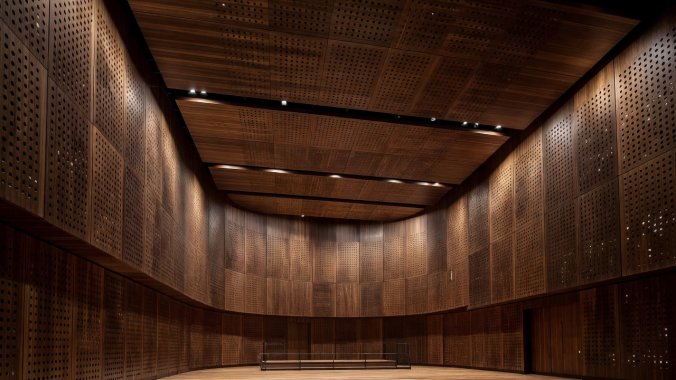
The Geometry of Reverberation: Wallace Clement Sabine
Until the late 19th century, room acoustics were considered an unpredictable craft. Wallace Clement Sabine at Harvard University formalized the field by establishing the mathematical relationship governing decay rate. The classic Sabine formula defines reverberation time ($RT_{60}$)—the time required for steady-state sound energy to decay by 60 decibels after the source ceases:
Sabine Reverberation Formula
RT60 = 0.161 * (V / A)
Where V is room volume in cubic meters, and A is total acoustic absorption in metric sabins (Σ S * α).
If surfaces are made of hard, non-porous plaster (α ≈ 0.02), sound waves bounce hundreds of times before diminishing. If walls are treated with dense fiberglass or open-cell acoustic foam (α ≈ 0.85), energy dissipates rapidly via viscous friction inside the pore matrix, heating the air microscopically.
Wave Interference and Axial Room Modes
Sound travels through dry air at approximately 343 meters per second (at 20°C). A 50 Hz bass wave has a physical wavelength of 6.86 meters. When this wave encounters walls spaced exactly 3.43 meters or 6.86 meters apart, the reflected wave aligns precisely with the incoming wave.
This creates standing waves or room modes. In certain physical positions, constructive interference doubles sound pressure, producing a boomy resonance peak. In nodes half an octave away, destructive interference completely cancels the frequency, rendering deep bass notes silent to the listener regardless of amplifier wattage.
"A small bedroom studio suffers far more severe bass distortion than a symphonic hall. In small enclosures, modal spacing is sparse and isolated, creating violent 20-decibel peaks and nulls."
— Acoustic Absorbers and Diffusers, Trevor Cox & Peter D'AntonioDiffusion vs. Absorption: Preserving Acoustic Life
Over-treating a listening room with thin porous absorbers strips high frequencies while leaving muddy low-end modes completely intact. This creates a muffled, unnatural acoustic space. To preserve brightness while eliminating flutter echoes (rapid ping-pong reflections between parallel hard walls), acousticians use Schroeder diffusers.
Quadratic Residue Diffusers (QRD) feature wells of calculated mathematical depths based on prime number residues. When a coherent wave strikes the diffuser, the reflected energy scatters evenly across 180 degrees in both time and space, smoothing reflections without suffocating room ambience.
Materials and Absorption Coefficients Table
| Surface Material | 125 Hz (α) | 500 Hz (α) | 2000 Hz (α) | Primary Acoustic Function |
|---|---|---|---|---|
| Polished Concrete | 0.01 | 0.02 | 0.02 | Maximum specular reflection |
| Unbacked Heavy Velvet Curtains | 0.07 | 0.31 | 0.70 | High-frequency damping |
| 100mm Rockwool (Framed) | 0.45 | 0.95 | 0.98 | Broadband velocity absorption |
| Diaphragmatic Membrane Trap | 0.80 | 0.25 | 0.10 | Resonant bass control |